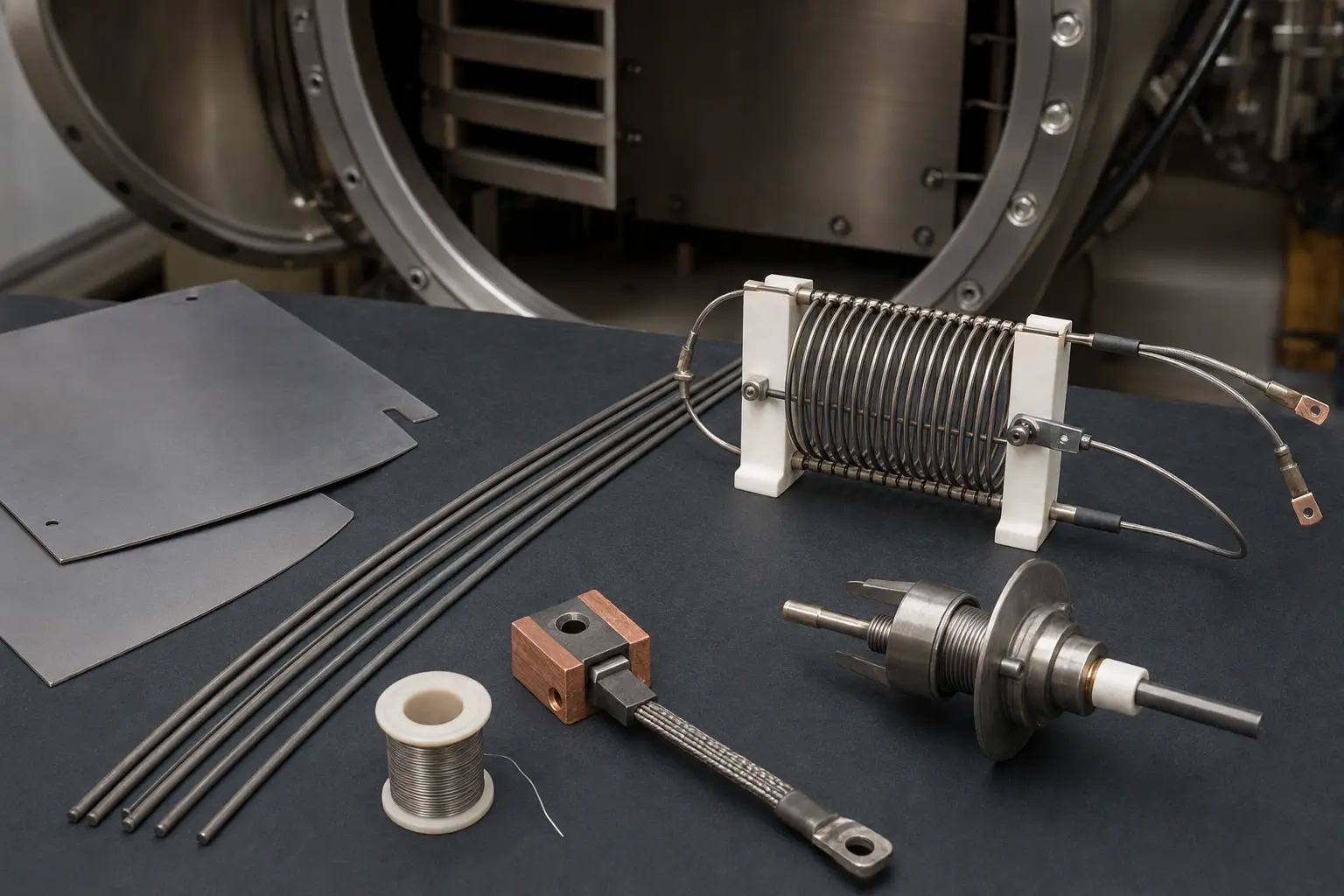
Tungsten- and molybdenum-based products are selected where high-temperature strength, vacuum compatibility, electrical or thermal performance and dimensional stability are important. Purity, composition and supply condition are project-specific.
This is a supplementary product and application area. Cemented carbide remains MPC's primary manufacturing focus.
W·Mo
Application map: equipment, parts and service conditions
This map connects the process or equipment position with representative carbide components, common failure mechanisms, material-review direction and practical supply form. It is a project review guide, not a universal specification.
Process / equipment
Position and function
Representative components
Main service risks
Material review direction
Typical supply route
Vacuum and high-temperature heating
Resistive heater or thermal-zone component inside furnace and vacuum equipment
Tungsten or molybdenum wire, heater elements, rods, plates and shields
Creep, recrystallization, thermal cycling, oxidation and joint failure
Review temperature, atmosphere or vacuum, electrical load, support spacing and joining method
Wire, rod, sheet or plate, formed heater, machined part or drawing-based assembly
Electrical contacts and erosion-resistant electrodes
Current-carrying or arc-exposed contact, electrode and heat-spreading position
Tungsten-copper contacts, electrodes, inserts and custom conductive components
Arc erosion, local heating, contact wear, thermal expansion and joining reliability
Match conductivity, erosion resistance, composition, density, geometry and duty cycle
Material blank, machined contact, joined component or finished electrode
High-temperature structural and custom parts
Support, fixture, crucible-related or thermal component exposed to demanding environments
W/Mo rods, plates, sheets, fasteners, supports and drawing-based parts
Distortion, brittle handling, thermal fatigue, contamination and dimensional instability
Raw form, cut blank, machined component, formed part or inspected assembly
What should be reviewed for this application
The application name is only a starting point. Material direction and manufacturing route should be reviewed against the actual load, wear pattern, geometry, mating parts and downstream processing.
Tungsten and molybdenum projects should be reviewed against operating temperature, atmosphere or vacuum, thermal cycling, electrical load, mechanical stress, joining method and dimensional stability. The suitable route may involve pure metal, an alloy or a composite, supplied as wire, rod, plate, sheet, powder or a drawing-based component. Purity, condition and inspection scope are therefore confirmed for the individual project.
What Defines the Requirement
Operating temperature, atmosphere, vacuum level and thermal cycling
Electrical conductivity, thermal management or erosion requirement
Purity, composition, temper, density and supply condition
Wire, heater, electrode, plate, rod or drawing-based component geometry
How MPC Can Support the Project
MPC manufactures representative tungsten and molybdenum wire and heating components, rods, plates, powders, high-density alloys, tungsten-copper materials and custom components. Final specifications are agreed for the application and order.
Manufacturing Built Around the Product Requirement
Our role is broader than supplying a catalogue item. We review how the material, product form, manufacturing route and acceptance requirements fit the intended application.
Quality requirements are tied to the product and order. We do not present one property table or one inspection plan as suitable for every material family.